

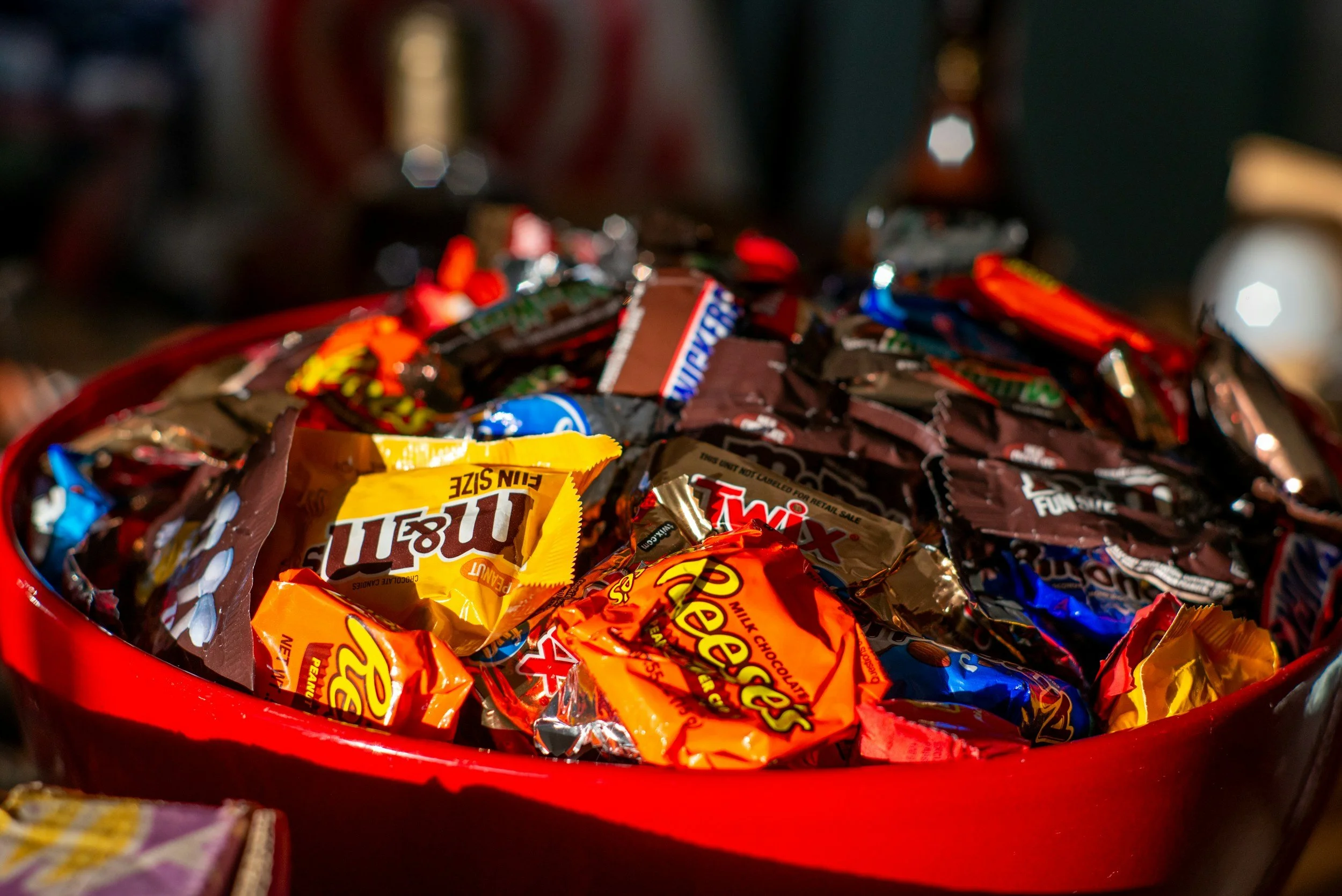
Do you ever breathe a sigh of relief when Halloween is finally done? The candy, the excitement, the big evening itself. It's a lot.
It can also stir up so many thoughts for us as parents: our own relationship with sweets and treats, what we think about bodies and body shapes, and how to fit treats into everyday life in a way that feels calm and steady.
If you're wondering what to do with the leftover Halloween candy on your counter, here's the short version: let your child enjoy it freely at first, then offer it at regular meals and snacks, and keep your tone calm and a little boring.
It's based on the Division of Responsibility in feeding, developed by dietitian Ellyn Satter. You decide what, when and where food is offered. Your child decides whether and how much to eat. The same idea works for Christmas stockings and Easter baskets too, so keep it handy.
How much leftover Halloween candy can kids eat?
For Halloween candy, Satter suggests letting kids lay out their haul, sort through it and eat as much as they want on Halloween night. The next day can look the same. After that, the candy gets put away and offered at meals and snacks: a couple of small pieces with meals, as dessert, and as much as they want at snack time.
Here's the thinking behind it. Satter notes that kids who have regular access to sweets tend to eat them in moderation, while kids who are denied access tend to overeat them, even when they're not hungry, and may beg, whine or sneak. When candy is available and predictable, it stops being such a big deal.
Already past those first couple of days, and the rules have been tight or keep changing? You can still reset. Tell your child calmly that candy will be offered at meals and snacks from now on, then follow through.
It's okay to just let kids enjoy their candy
Food is meant to be pleasurable. The taste, the crunch, the melt, the fun of choosing a favourite from the pile. Enjoying food is an important part of life, for kids and for adults, and candy is allowed to be part of that. It doesn't have to earn its place or come with a lesson.
When a food is treated as shameful or off limits, kids pick up the message that wanting it is something to feel guilty about. When enjoyment is allowed, candy is just one more food that tastes good.
What's the plan for the candy pile?
Start relaxed. Sit down with them, sort the pile, trade favourites and enjoy it together. This is the time to hold back your commentary, and to enjoy some yourself.
Move candy to meals and snacks. If they ask at other times, a calm "Not right now, we'll have some at snack" is enough. Candy works best as plain food, not a reward or a bribe, which only makes it more important.
Keep it somewhere simple. A cupboard or container works well, and your child knows where it is and when it's offered. Satter suggests kids can keep control of their own stash as long as they can follow the plan, and if that gets hard, a parent holds it until they can.
Let it get boring. This takes patience. Over time you might find a half-full bag nobody has touched. That's a good sign.
Want to try a candy tasting?
Here's a fun one that turns the pile into a little experiment. It takes about ten minutes and works best on a day that isn't hectic.
Sit down together with a small plate and a few candies your child picks out. Then get curious. There are no right answers, and no one has to finish anything.
What's your favourite treat in the pile? What do you like about it?
What flavour is it? Sweet, sour, salty, fruity, chocolatey?
What's the texture? Crunchy, chewy, smooth, melty, sticky?
Do you have a favourite chocolate bar? What makes it your favourite?
Take a slow first bite. What does it smell like? Does the taste change as you chew?
Is there one that sounded better than it tasted?
Join in with your own answers. Kids love hearing what you like, and it shows them that tastes are different and nobody has to pretend to enjoy something.
Slowing down to notice flavour and texture helps kids tune in to what they actually enjoy, instead of eating whatever's closest. A treat you really like also tends to feel more satisfying. Keep it low-pressure, and if they'd rather skip the game, that's okay too.
What if my child never gets bored of candy?
Some kids still want candy weeks later. That doesn't mean the approach isn't working. Check that meals and snacks are regular and the plan stays steady, then give it time. For kids who have had a lot of restriction in the past, it can take longer for candy to lose its pull.
Here's another idea: see if your child is willing to set some candy aside for a ski day, a camping trip or a movie night, so the whole family can enjoy it. Even part of the stash works, and it goes best when it's their choice.
You can also invite your child to pull out the candies they don't really like, to give away or donate. Sorting what they love from what they don't is part of the fun, and it's their call. Chocolate freezes well, and some candy bakes nicely into cookies.
Why does candy bring up so much for us as parents?
Are you ever sitting there while your child goes in for yet another piece of candy and your skin crawls? You're in very good company. Tune into that feeling. It's telling you something about you.
It's rarely just about the candy. A lot of it comes from our own history: the treat rules we grew up with, diets we've tried, and the comments about bodies we heard (or made) along the way.
Kids notice, too. One of the core ideas in pediatric feeding is that kids learn about food by watching the adults around them, including how we talk about treats, diets and bodies. Strict food rules and diet talk tend to make food feel more charged for kids, not less. This isn't about blame. Most of us are doing our best with what we were taught, and our own habits are the part we can change.
A few questions to sit with, ideally not while standing next to the candy bowl:
What did treats mean in the home I grew up in? Were they earned, hidden, forbidden, or a way of showing love?
What do I feel when my child eats a lot of candy?
Do I believe some bodies and body shapes should only have certain treats, while others can have whatever they like? Where did I learn that?
As you think them through, notice where your beliefs about food, treats and body shapes came from. Which ones are serving you? Which ones are you ready to move through? And what do you want the story around food and bodies to be for your family?
What if I'm worried about my child's weight?
It's a common worry, and it comes from love.
The plan stays the same for every child in your home, whatever their size: regular meals and snacks, sweets included. Your child's body size doesn't tell you whether it's working.
When should I talk to a dietitian?
It may be worth reaching out if:
Your child is hiding or sneaking food, or seems very distressed around sweets
Candy is causing daily battles that spill into other meals
Your child is skipping meals or eating very little other food
Your child's doctor has talked with you about their growth
Your own worry about food or bodies is affecting how mealtimes feel at home
I'm a Calgary registered dietitian, and I see families in person and virtually across Alberta, Yukon, the Northwest Territories and Nunavut. You can read about family nutrition and feeding kids or book a free discovery call.
Frequently asked questions
Should I throw out the leftover Halloween candy? Not in secret. Kids who feel their candy could disappear tend to sneak it or rush through it. If some of it is going, let your child be part of that decision.
What about the Switch Witch, or buying candy back? Some kids love it, and it can work when it's truly their choice. If it feels like a trade under pressure, or candy is described as something that needs to go, it can backfire and make candy feel more special.
This article is general information, not individual nutrition advice. If you have questions about your child, a registered dietitian can help.